Scimitherasia

Kingdom of Belara
Symbolism: A black boat on a white background. Boats made of black Oak were once the most feared ships in the outer sea. This flag recalls that ancient symbol of naval dominance even if the ships are gone. The wings on the ships are a controversial symbol of the royal family who is said to be descended from winged angels.
Lore: Belara is an island nation in the northern Outer sea of Scimitherasia. It considers itself the ancient rival of the Varań Empire with claiming the true title of sucessor of the City of Glass due to the preported divine parentage of their ruling line. For centuries they had badf relations with the other countries following the Church of Divine Duality due to that. The country is gaining increased power due to their lucrative colonial enterprises.

Leixi-Auroxian Commonwealth
Symbolism: Their flag represents this duality. The crossed swords act as an euphemism for bull horns and represent Auroxia while the spear represents Leixi. The purpur represents Leixi and the Cyan Auroxia. They are bound under one crown and share one cavalry-shield-crest. An unbroken chain of steel (oblication) and another of gold (the divine) binds them inseparably. Lastly an axe symbolises the defeat of Paganism.
Lore: This is the flag of the Leixi-Auroxian a union of two states. The gallant Leixi descendants of the Boar tribes known for their skill with the spear and cavalier arts and the Auroxians the last pagans west of the world spine, former Bull tribe. Their holy bulls have been slain and not by sword, but by marriage they were covnerted to the Church of Divine Duality by Leixi.
The Laixi-Auroxian commonwealth are known for their elite Hussar units, of whom one even managed to defeat a Grayskin Divien Bull rider from Araxia in a knight tournament. More controversially they are known for turning a blind eye to heresy (religious tolerance) and for unauthorized trade with the Withelves.

Morlloux
Symbolism: The book represents the holy book of the faith and allegiance to the CoDD and sarkation, the gun a progressive state and the fight for freedom. The crown and violet hat display the absolute power of the monarch combined with his status as a fellow of the revolution. The repeating double-rotared-square shapes are a symbol tied to the CoDD representing the 2 faces of the divine duo.
Lore: A nation with a long history as a a province of the Varań empire. They were taken over by Belara during the collapse of the Varań Empire. Historically a very controversial moment. Since then the possition of Morloux within the Belaran Empire was vague even having had dominance of the Empire in certain time periods.
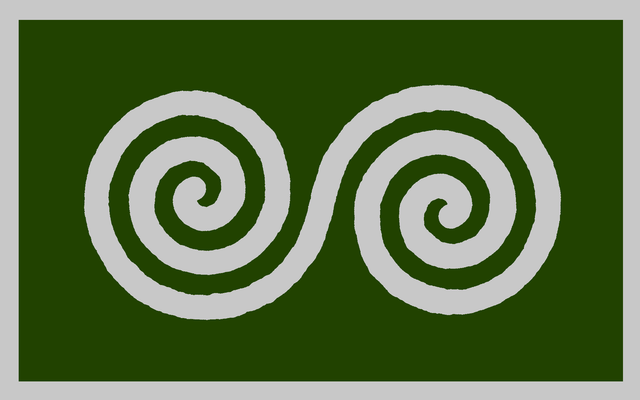
Storm Islands Condeferation
Symbolism: the tweo connected spirals represent the 2 islands of the archipellago. The white/metal spiral over a dark green flag represents the dominance of the white metal druids over nature.
Lore: The storm islanders are considered borderline-heathen heretics due to practicing druidism. Their druidism comes hoever not from a veneration of nature, but from a use of white metal they inject as a conduit for nature magic. Thus saying their ways are ones that follow the teachings of the Divine Duo about subduing nature. The storm islands are technologically quite backwards with their state functioning as a tribal confedetration with a ceremonial King. They maintain independance thanks to partial controll over the storms which rage around their island.
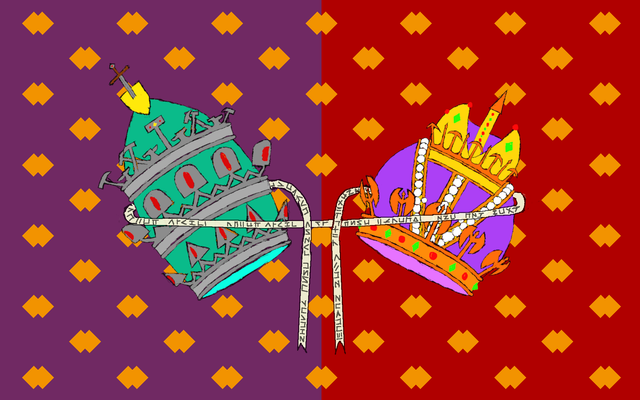
Theocracy of Sarkatio
Symbolism: Red and purple represent nobility and conquest. The two cowns represent the two heads of the Church the Prince who heralds the male face of the Divine Duo looking forward his crown is tall adorned with steel. The other crown is for the Princessa and is purple and bronze representing the maintainance of tradition. Bronze axes were the first to cut down the holy trees of the druids.
Lore: A holy state which formed around the Ceremonial Capital of the old Varan Empire. Known for their duelist tradition and being a gathering place for the most talented artists.
The Great Bog
Lost Giant's Coast
Old Khenomeria
Shifting Steppe

Belaran Norum siń Siejmfenk
Symbolism: A mine, paddle and a blackie. The 3 pillars of the colony, ships/fishing, the local coal mine and the local 'blackie' farms.
Lore: Norum siń Siejmfenk was established as an overwintering-port. One can only sail to Qi-Fu in summer. Be too slow and your ship will freeze over and you will die. This heavily limited shipping. As such an over-wintering port was created near a site where coal deposits were found to help keep warm. Due to it's inhospitable conditions the place is a sparcely populated penal colony, hower it's of increasing interest to anthropologists wishing to study the arctic goblin and elf tribes.
Azaya

The Ta-Li Hold
Symbolism: Named in the Qi-Fu'am language "next to/at the foot of the big mountain" *Belarans misinterpreted it as Forest Mountain settlement, mistaking the 'big' symbol for a tree and associating it with the name of the bandit organisation who owned the place before the. "The Green Forest Bandits". On the left under the flag you see it in Belaran. They use the Varań script. On the right the inscription in the logographic Dragon Tongue script colloquially known as Qifuan
Lore: The area at the coast of current Ta-Li was sold to the Belaran Empire as a 'scam' the area was a stronghold of local bandits. Said bandits being practitioners of martial arts it was basically a rogue sect. No one actually expected Belara to take control of it. However they did and transformed it into a prime trade port. From which drugs would flood Qi-Fu when the Dragon Emperor tried to ban sale of drugs, the Belaran army stormed the very capital of Qi-Fu greatly expanding the hold. This relocation of troops east lead to the sucessfoul Merloux war of independance and a reliance of the Belaran Empire on the Ta-Li hold as the source of most of it's wealth and a large amount of it's standing army in form of the Foreign Legion.

Cherry Blossom Swordsmanship Sect
Symbolism: The flag has in it's letters the name of the school. Which is a chracters for 'cherryblossom swordsmanship martial arts' and the chracter for sect or martial arts school/organisation which is neither a religious organisation or a martial family. Only the highest ranke institutions are granted single chracters to use on their flags. Lesser sects use 2-5 character long names.
Lore:This is the Flag of the Chrryblossom Swordsmanship school a prestigous martial arts sect in Qi-Fu. The sect traces it's traditions back to aesthetic practices from even before the invention of the Taisen arts. Their swordsmanship focuses on being immovable as a tree yet hitting as gently as a flower petal. Their swordsmanship is mainly known for their beauty and their sect for mostly only taking in disciples from noble families and selecting based partially on looks.
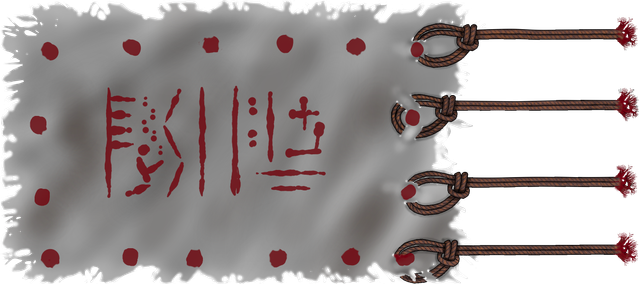
Begger's Sect
Symbolism: The flag can have some variance like the dots around being zig-zags, replaced with lines etc. The opened bits at the end of the ropes are however always dyed. (note the flag is near always a dirty white as peasants/beggars in Qi-Fu are not permitted to dye their clothes. It will however have different tints of color depending on the kind of dirt the dead beggar lived in)
Lore: This is a very different flag. It's the 4-knot warbanner of the beggars sect. The beggars sect usually avoidst he spotlight however it's most competent representatives will fashion these flags in case of conflicts with other groups in the martial arts world. Only '4 knots' (warrior of highest status within the sect) are permitted to fashon war banners (number of knots in ones rope denotes status within the sect) and in most cases the banner is raised in case of a sect massacring beggars/homeless. The flag is fashined out of the tunic of a dead beggar and adorned with the blood the martial artist and the rope of his knots. As such unlike other Qi-Fuan flags the symbols are not a form of careful caligraphy but rather simple doodles. made in blood.
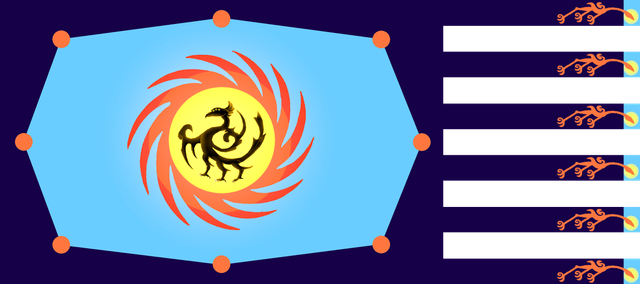
San Zuu Sect
Symbolism: Well they are here. This is the flag of the San Zuu sect the only faction of the martial arts world (outside the New Green Mountain) which admitts foreigners/westerners.
While not a major sect they are rapidly growing in prominence. For millenia they have existed at the fringes of Qi-Fu society due to their heretical aspiration to reach beyond the dragons and instead emulating/sworshipping the Sun and the 3 legged 3 eyed crow which.
Being a minor sect the Imperial scribes of the Dragon Throne have reected their pleas for a granted true symbol. As such their true name is 4 characters long - it's what their flag used to contain. Having settled in the Ta-Li hold they have adopted the Sun whoc banishes the stars and the Bird who ate dragons as their main symbol instead.
Lore: This is the flag of the San Zuu sect the only faction of the martial arts world (outside the New Green Mountain) which admitts foreigners/westerners. While not a major sect they are rapidly growing in prominence. For millenia they have existed at the fringes of Qi-Fu society due to their heretical aspiration to reach beyond the dragons and instead emulating/sworshipping the Sun and the 3 legged 3 eyed crow which. Being a minor sect the Imperial scribes of the Dragon Throne have reected their pleas for a granted true symbol. As such their true name is 4 characters long - it's what their flag used to contain. Having settled in the Ta-Li hold they have adopted the Sun whoc banishes the stars and the Bird who ate dragons as their main symbol instead..
(the 4 symbol version of their flag will be later provided for comparisson of flag making styles)

White Dragon Clinic
Symbolism: Clinics as a unique organisation type are quite new as historically they are extensions of existing martial arts groups. Even as they became more distinct, many symbols were used to denote a clinic. The distinction of using only one hcaracter and a checkerboard was granted by the Mai Xi emperor after the events of the Blackscale Emperor's overthrowing - the ones granted this distinction first were the White Dragon Clinic. At the time heralded by a single 'divine physician' the White Dragon Clinic rose directly to oppose the Back Dragon who had ursurped the throne. The colors used in the flag have been chosen to maximise visibility, rejecting any deeper symbolic pursuits in the face of pragmatism.
Lore:The best medical organisations in Qi-Fu are tied to the martial arts world as being able to read and manipulate Qi as well as having superhuman physical abiltiies is quite useful for a doctor. Many Clinics practice poison arts however the White Dragon Clinic abstains from that. It is a relatively young organisation tracing it's founding back to the brutal reign of the Black Scale Emperor withing to conquer the Death the Black Dragon brought with the life the White Dragon did. The White Dragon Clinic while being by far the most skilled are distrusted due to their ties with Maoswaerum (importing surgeons from there) as well as their high prices (rich patreons to be treated are expected to pay 3-5 times the usual price to fund free treatment for poor patreons)
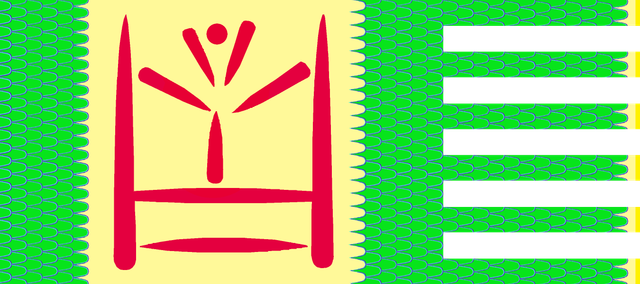
The Dragon Throne under the Qi-Fu Dynasty
Symbolism: The Flag of the Dragon Throne is the only one that contains only one character (with exception of medical groups which use a chess-board pattern in place of a second symbol). The green is the signature color of the Qi-Fu dynasty, whiel the yellow is a promise of prosperity and red symbolizes the blood shed to enthrone the dynasty. The flag is covered in scales which usually are harvested from spirit-crocodiles (before that from serpents, but this has been banned since the blackscale emperor)
Lore: The Flag of the Dragon Throne. It represents the entire nation of Qi Fu. The different dynasties only tend to change the color of the scales. The blackscale dynasty used black scales and the colors red and white as complemtory while the Mai Xi dynasty used purple, cyan and gold
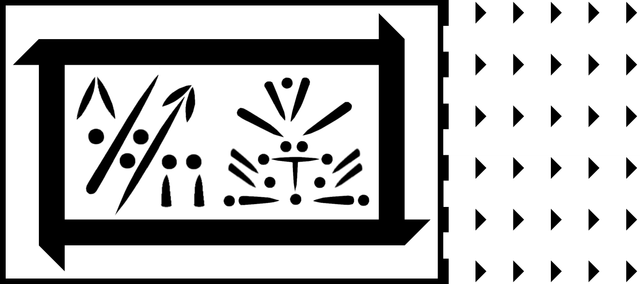
Żegal Clan
Symbolism: Black and white represent the ridgid uncompromising mentality of the Żegal family.
Lore: Being a martial clan they are built around one family which passes on their martial arts through the bloodline. The Żegal clan are known for their spearmaship.
Anininishina
Ekura'var

Belaran White Sand Islands
Symbolism: The 'x' shape represents two corssed bones which is a symbol of 'promise' among the locals. It represents the rightful purchase of the islands. There is 2 X's due to this colony being a merger of two separate holdings.
Lore: The colony once was comprised of many small colonial posessions, however only these 2 remain after the Black Sand Pirates took control of the region. Nevertheless the white sand islands remain a massive exporter of sugar cane and other expensivep lantation goods. The proffitability of the colony somewhat fell after the aquissition of Janedi holdings by Morloux, however since then aquisition of rare magical 'divine fruit' helped cover the losses.
Yurbormel

Belaran Kakalisima
Symbolism: The red-black symbols are taken from the wood decoarating art of the local Hekkartel dwarves.
Lore: The original Hekkartel colonies were lost to Morloux during their independance war, however since then Belara built new colonies and retook some of their original ones. The Hekkartel colonies are mainly used for securing power in the west and purchase of expensive goods such as obsydian, jade and pearls from the locals.

Seat of the Demonlords
Symbolism: The colors on the flag are most bright and saturated to represent the highest level of power of the demon lords. With each of the 6 colors for each typew of demon equally represented. Demons are obsessed with status, thus rather than aesthetics being the main consideration in flag design the most important is expressing ones status and being represented on the flag. it is said that decades of fighting and deliberation predate the creation of a flag design which represents all demon races equally as all wished for a possition of primacy. Even where the color is located on the flag was a question of controversy with eventually dice being thrown to determine i.
Color symbolism: Cyan - Himshalendar (Ice/Law Demons), Red - Agniketu (Fire/Violence Demons), Pink - Vayuparichar (Lust/Wind Demons), Yellow/Gold - Asuuryulu (Stone/Greed Demons), Dark Gray - Sarpottar (Thorn/Sadism Demons), Green - Nagabhushan (Snake/Temptation Demons)
Lore: Flag of the 6 deamon realms. The 7 types of Demon Lord all rit in circle aroudn the hole that leads to hell and govern the realm. This flag represents all of Demonman kind and may only be flown if an order coms directly from the Demon Lord council.
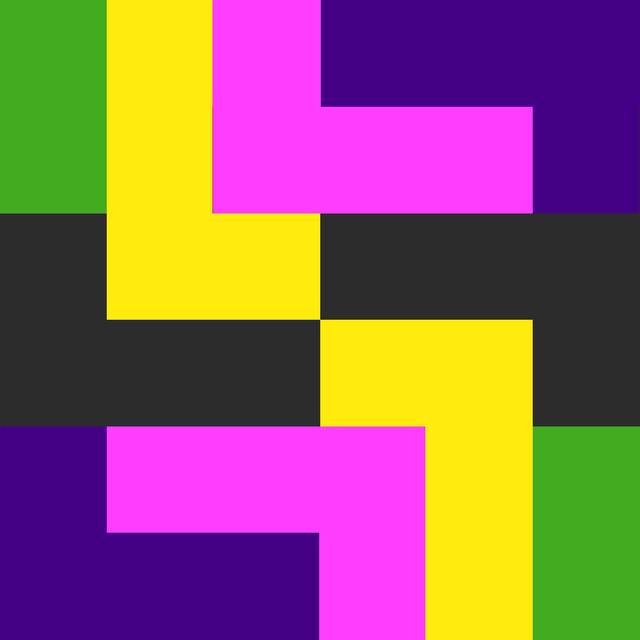
Karaganari
Symbolism: Karaganari features an additional color. Purple which belongs to Vsmpires, while considered demonic they fall outside the standard demonic chierchy. One can see that 4 types od demons dominatet he city: Lust, Thorn, Vampire and Greed - with the Snake Demons only barely holding on to power. Usually Nagabhushan hold quite high prominence in the regions far away from the hole to hell due to taking over the meluz nobility of the upper world, but in this specific city they appear to have been deposed via cooperation of vampires and vayuparichar to establish a city open to the outside world. An open air brothel and centre of trade.
Lore: Free city of Karanagari. A city on the coast where only lower demons dwell. Who rile there are the demons of lust, thorns and greed. The less important types of demons are pushed to the side. Notably you find 'purple' represented here. The color for vampires a race which while of different origin easily integrated with the cannibalistic Demonmen.
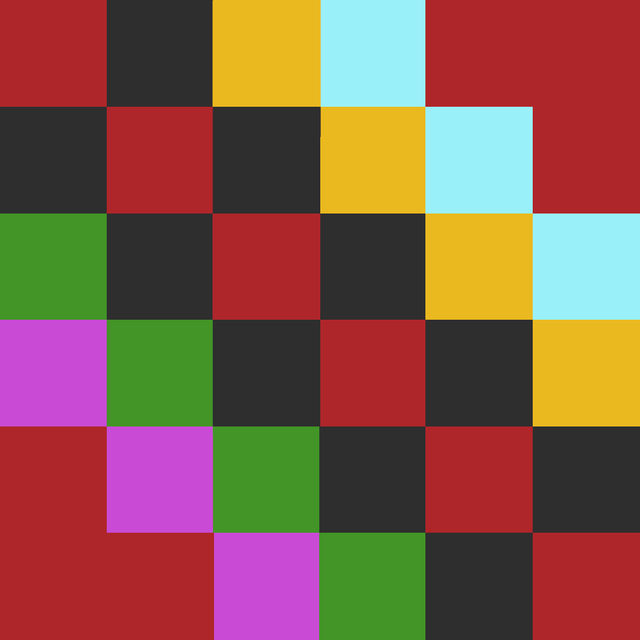
Vehjar'lankas
Symbolism: His flag is heavily dominated by the red which is most saturated. Representing his dominance and the rule by his flame demons, however Thorn demons who manage the human sacrifices are also given an elevated status.
Lore: The realm of the wayward demonlord of Violence and Fire Vehjar'lankas. Also known as the ''1000 hells general'' he attempted to dig his own hole to hell in a spot where the connection seamed weak, this howevetr failed and he now dwells on the bottom of the unifinished hole kept around only due to mass human sacrifice. Despite being a Violence Demon he is known as the greatest general in all of the Demon realm with other demons coming to pay him tribute in hopes to get his advice on tactics.

Daftrantragen
Symbolism: The realm of the Pale Treant. At it's core the flag has a the leafless tree representing the pale treant himself, the 8 euqual races of the realm and the two black circle 'the fruit of the tree' are placeholders used by local warlords to put their own symbols there! A new color seen in the flag is 'brown' representing mortal races lumping humans, dwarves and halflings together. Notably the nation also includes dryads which however are considered 'parts' of the Treants, part of the pale leafless tree. In some cases they are considered within brown or green hoever.
Lore: Daftrantragan the realm of the treant without Leaves. A young treant warlord lead his war party into the demon realm and though his skill he won, but rather than integrating his realm into the great forest he tasted flesh and blood and became half-demon himself. And so Daftrantragan the realm ruled by the tree without leaves was born. His subjects include both the races of the great forests and of the demon world as equal, for his dream is to one day fully conquer both realms and then the whoel world!